The rules of Scratch Ticket Radio are simple. During a trip to a record store, I put aside $10 to specifically spend on a few used 45s. The $10 limit is firm, so I end up with different amounts of records depending on their prices. Consistent with the gambling analogy, I do not listen to them in the store before I buy them, and I cannot select 45s by artists that I already know or that contain songs that I am already familiar with. Then, once I have them home, as if taking a quarter to a scratch ticket, I listen to each song to determine its quality. If I come out with more keepers than duds, the ticket as a whole can be considered a winner.
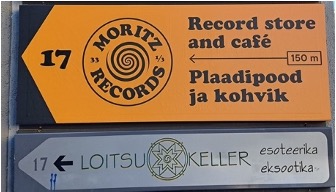
Old Town Tallinn: Moritz Records
September 2024
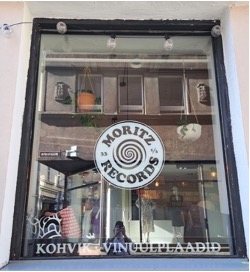
In August, I visited Finland for just shy of two weeks (see Audio Miscellany October 2024). On one of the days, me and my older child joined my cousin (who had organized the trip) and her family on a ferry over to Estonia. The trip is only about two hours, so you can kick around Tallinn for the day and then take the ferry back to Helsinki that evening. Near the end of our time there, my kid noticed the sign above. They had to know what would happen next, but they indulged me. It was a small store, with a living-room sized main floor and then a tiny room that you accessed up a set of steps. That room was dedicated to Estonian music. The ground floor had a little bit of everything, and the walls had a slight bias towards the 60’s and early 70’s rock. Nobody was drinking coffee. In the 45 section there were expensive Jamaican singles, which I seem to see everywhere now, but also some cheaper stuff. This is what I found for my €10 (Approximately $11.15 with the exchange rate).
Goombay Dance Band (CBS / 1980)
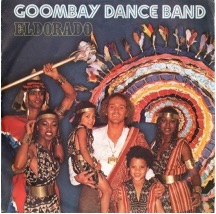
El Dorado: Each side of this single produced a completely different WTF reaction in me, which is actually kind of impressive. El Dorado sounds like a sci-fi version of Paul Revere and the Raiders Indian Reservation. The song is about colonization and the destructive search for gold, but it is a bit hard to take seriously because of the laser shots and synths. And also the costumes. And also the spoken word passage where they intone, “The Real El Dorado is in your heart.” I mean really, WTF?
Love and Tequilla: This seems to be more in keeping with the rest of the Goombay Dance Band’s work – mushy “world” music with a heavy dose of Caribbean sounds and mock Spanish. Here you also get ai-yai-yai’s in the background because, you know, tequila. The cover is telling. The guy in the middle assembled the band and is the lead singer. The other folks are wearing a mix of ‘ethnic’ dress that seem to be from no particular culture, century or planet. When I’m feeling more snarky than cynical, I would describe the vibe as Richard Branson asked a Benneton intern to assemble a family for a “native themed” LARP weekend. When my cynicism takes over, the white guy among a collection of smiling young people of color thing strikes me as slightly cultish, like Jim Jones crossed with Sun Ra. As it turns out, the Goombay Dance Band were from Germany, and they had million selling records in some European countries and South Africa. WTF?
Lidija Kodriča (МЕЛОИЯ (Melody) / 1975)
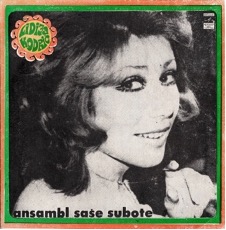
I couldn’t tell by the cover, but this was released in the Soviet Union. Rather than a single, it was a four-track EP. I think Lidija Kodriča was from Yugoslavia, but it has been hard to track down much other information about her. She also did some acting. Or perhaps she was an actor that did some singing? There were no videos that I could find, so I digitized the songs myself.
Dejojot Mēnesnicā: Well, I accidentally violated a rule because I did actually know this song. Not because of some vast knowledge of Yugoslavian music from the 1970s, but because it is a cover of Dancing in the Moonlight. This version uncovers the showtune at the heart of the song. I can picture her on stage with a dozen or so dancers in garish skirts and flashing lights. And maybe her name in big lights at the back of the stage.
Mans Dziedonis: All I can say is that this is a more of a traditional Eastern European song, in the form of a ballad that picks up speed until it gets to the “lai-lai-lai” chorus. My ignorance doesn’t allow for a more fine grained identification, or for a nuanced appreciation.
Na-Na-Na: Early 70s pop, on the other hand, is something I know too much about. Being exposed to it in vast quantities changed my brain in some way. Apparently the folks in Yugoslavia couldn’t escape it, either. I can see the crowd waving their hands in the air, as if they just don’t care.
Kabare: OK, this was also a cover. If I knew it was one in advance, I probably could have guessed from the song title. Her rendition is perfectly competent, but I don’t really like the song too much in the first place so there was a built-in ceiling for how much I was going to enjoy it.
Leegajus (МЕЛОИЯ (Melody) /1975)
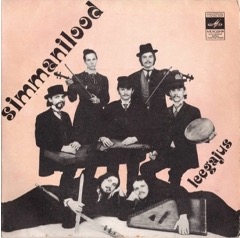
Simmanilood: This is from the same Russian label, but Leegajus was (is?) an Estonian band. It is five track EP of traditional village dance music. The sound is mostly kantele (also an important instrument in Finland) mixed with violin. I am somewhat entranced by the sound of the kantele (and other zither-like instruments), so this was my jam. The back cover provides information in Russian, Estonian and English. My favorite piece of information: “The rhythm was beaten with a triangle, a small drum (a tambourine), a broomstick or sometimes a bow-shaped instrument (jaurum or umba). Other means were also allowed, like beating a ladle against a stove-door or a pot-lid, depending upon the mood of the players.”
Oddly, in the Estonian column, there are names for each of the songs, but in the English column it just lists the type of songs. It simply reads: Waltz, Polka, Polka, Rhinelander, Waltz. Thanks to Google Translate, I figured out parts of the names, but not entirely. I also had to look up what a Rhinelander was. It’s a couple’s dance that is a variant of the schottische, common to parts of Central Europe and Scandanavia.
Songs: Vändra Valss (Crank Waltz) / Kahe Duuri Polka (Polka in Two Majors) / Polka Piira Peeter / Vahetusega Reinlender(Reinlander With a Shift) / Valss Orn Kevade (A Waltz About Spring?)
Luv (Carrere / 1978)
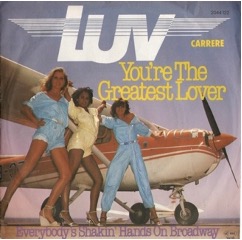
You’re The Greatest Lover: To my ears, this sounds like a hotel band from Rotterdam playing ABBA at a polka fest. But what do I know? They sold a million of this single. In fact, Luv were big stars all over Europe in the late 70’s early 80’s, and sold more than seven million records across their career. They were assembled in the traditional girl group fashion by producers who had songs but needed singers to fit an image. I wouldn’t have guessed they were Dutch from the cover, since their name and the song title seems like it could be from just about anywhere.
Everybody’s Shakin’ Hands on Broadway (Skip to the 2:53 Mark): I have no idea what they are on about here. Is everybody getting deals done? Is everybody doing jazz hands? Is everybody just friendly? What did Dutch songwriters think was actually going on in 1970’s NYC?
Mysterious Art (CBS/ 1989)
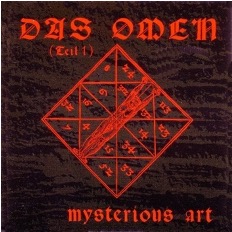
Das Omen (Radio Version): This song started off as something closer to the B side – an instrumental aimed at German dance clubs. It got so popular that the band/producers decided that it could cross over if they added vocals to it. They were right. Upon release, it hit #1 on the German charts and stayed there for nine weeks. I can see why – it is really catchy.
Das Omen (Instrumental): The lyrics for the radio version, as much as I can make our, are kind of goofy, but I think they do their job. That said, I think I prefer the instrumental version once you get past the sturm und drang of the intro. It might be the added percussion, not sure. With this one, you can just dance and not have to worry about what they are singing.
Silent Circle (Blow Up /1986)
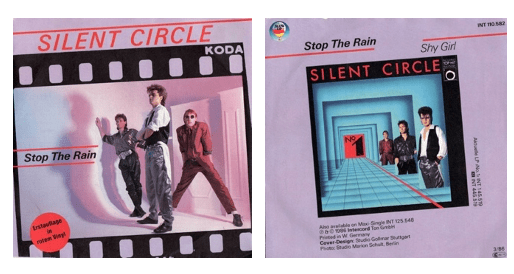
Stop The Rain In the Night: German 80’s synth-pop. Sadly, they are not nearly faux-icy as I expected based on the cover of the single. However, we do get this classic line: “Stop the rain in the night, in my heart deep inside.” It is almost an image of something emotionally resonant. Almost. It just proves that we didn’t need Generative AI to come up with language that is grammatically correct but doesn’t actually refer to anything – music producers have been doing that forever. The video is also really something else – I don’t know that it could be more 80’s. It makes the Das Omen video look sophisticated and restrained.
Shy Girl: This is the requisite ballad on the B-side that I can imagine was in some German rip-off of Valley Girl. Maybe the cover is a Milli Vanilli thing? I mean, how could three obviously wicked cool dudes produce a tune this boring?
SUMMARY
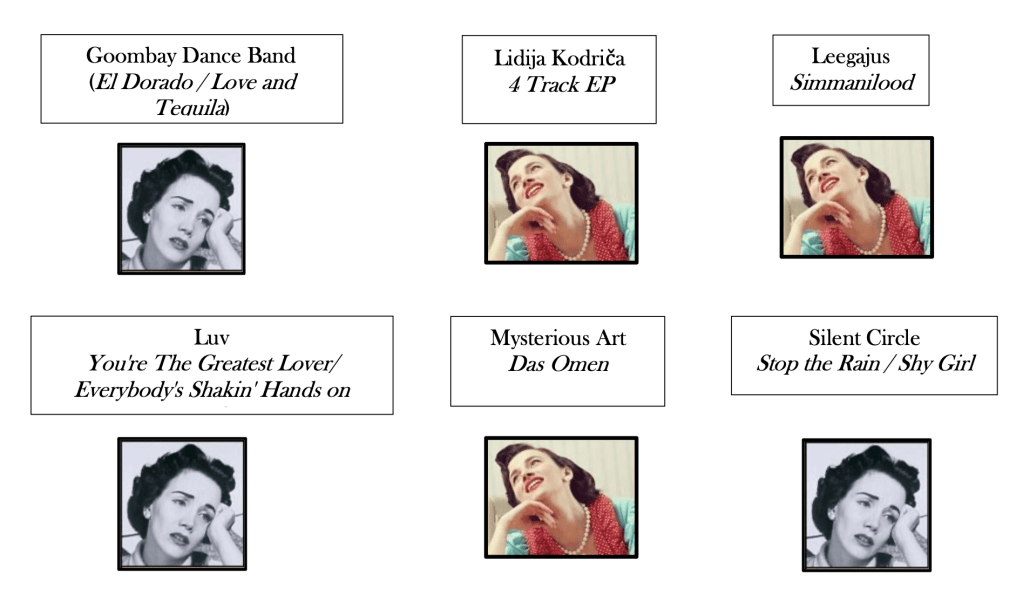
Getting to stop at Moritz Records during my day in Tallinn was a nice suprise, as were the records themselves. I certainly can’t complain about the results.
Anybody care for a Rhinelander?

