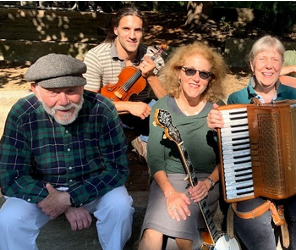
I have known David for more than thirty years, and we met via our shared interest and commitment to adult literacy. I immediately recognized David’s empathy, wisdom and curiosity, but it took a long time for me to discover that he was a musician and a member of the Gloucester Hornpipe and Clog Society. It is always wonderfully humbling when you learn something important about somebody you have known for a while. David (in hat) plays a number of instruments, including the bodhrán, spoons, bones and pogocello.
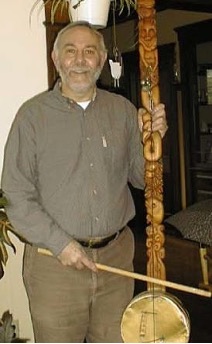
He was a founding member of the group, and has been part of it for 50 years. They play songs and tunes from several traditions, including Celtic, French Canadian and Swedish. David has a particular affection for maritime songs, so there are many examples of those in the group’s long history. You can get more information about the band and check out their albums on their website. There is also a documentary that includes reflections from many of the band’s alumni.
As with many bands, the backstory to their name is an amusing bit of serendipity. They were playing a supper at a church in Gloucester (MA) and the minister, wanting to introduce the band, asked what their name was. They didn’t have one, so they needed to make one up on the spot. David looked at the music stands they were using, which had a hornpipe on one side and a clog on the other, and said, “We’re the Hornpipe and Clog Society.” The minister then announced them as “The Gloucester Hornpipe and Clog Society.” Nobody from the group is actually from Gloucester, but the name stuck and they have played there a few times over the years.
Since they are a folk group, they actually play the tunes and songs that inspire them. For that reason, David identified five original songs and an original tune and six traditional songs the group has recorded. There are links for each, along with album liner notes and David’s comments.
Original Songs
1. An American Army of Two (By Diane Taraz and Jim Gleason)
“During the War of 1812, as British ships blockaded the coast and raided coastal communities, the teenaged daughters of a Scituate lighthouse keeper saved their town through musical subterfuge. When they saw a barge of Redcoats approaching, Abigail and Rebecca Bates hid with their fife and drum behind the dunes and made such a racket that the Lobsterbacks mistook them for a Yankee encampment. This song evokes the tune they played: Yankee Doodle, whose ancient melody was known as “the air from who knows where”, which was the name of this album. Our band also had the privilege of performing this song at the re-lighting of the Scituate lighthouse in 1994.”
2. The Children’s Hour (By Diane Taraz, with lyrics from the Henry Wadsworth Longfellow poem of the same name)
“In Longfellow’s beloved poem about his daughters ambushing him in his study, he compares their flurry of kisses to the experience of the 10th-century Bishop of Bingen, who, according to German legend took refuge in a tower on the Rhine River to escape a horde of mice sent by God to devour him in retribution for his cruel misdeeds (This was an obscure reference even in Longfellow’s day.) Among other places, our band performed this song at several of our summer and fall concerts in the Longfellow historic house in Cambridge, Mass.”
3. The Patent Leather Waltz (By Lynn Noel)
“Lynn interviewed former shoe-mill workers in the Merrimac Valley and shaped their memories into this song. They recalled the joy of waltzing on Saturday nights to such favorites as Golden Slippers. Lynn decided not to argue with the 90-year-old women that Golden Slippers is not a waltz — but we suppose now that we have recorded the song with this title, it is.”
4. The Ballad of Deborah Samson (By Diane Taraz)
“The Massachusetts State Heroine, Deborah Samson, enlisted in disguise after the Revolutionary War was officially over, when Tory raids made the army desperate for soldiers. Her steadfast service was rewarded with a military pension, signed by Governor John Hancock in 1792.”
Bonus Info: Deborah Samson was born in Plympton, MA, where my father lived for over 40 years.
5. The Sea Serpent of Cape Ann (By Diane Taraz)
“Sightings of His Snakeship, as the newspapers dubbed it, have tailed off since its notable tour of Gloucester Bay in 1817. The reports said it was as long as a ’74’, a large sailing ship.”
6. Message in a Bottle (By Nancy Koch)
“Nancy composed this tune decades ago, well before Sting composed and performed his own better-known song by this name in 1979. Nancy and our band have performed it for decades and as recently as in 2025.”
Traditional Tunes and Songs
7. The Diamond (A traditional Scottish song)
“This song probably dates from the mid-19th century, inspired by the hardy Scots who hunted whales in the Davis Strait, between Greenland and Canada’s Baffin Island. One of the ships that is toasted in the song, the Resolution, was crushed in the ice in 1834, a common fate in these dangerous waters. The song does not dwell on the hardships of whaling but on the joys of a full load, including the sailors promise to their tearful lasses that upon their return they will rip up the bedclothes in celebratory ardor.”
8. The Easy Winners (By Scott Joplin, arranged by band member John Berger)
“Our band performed this fabulous tune by the African American composer Scott Joplin at the competitive International Folk Festival in Letterkenny, Donegal, Ireland in the early 1980’s. We were thrilled that we came in second place.”
9.The Factory Girl’s Come-All Ye (A traditional New England song)
“Like all good work songs, this one from the mills of Lewiston, Maine, includes a great deal of complaining. The girls who sang it in the early 1800s rose before dawn to work a 14-hour day and they sent most of their earnings home to the family farm. We understand that versions of the song have traveled as far west as Texas and south to the Carolinas.”
10. The Rosabella
David says this is a rousing capstan chantey, used to gather crew members who together hoist the ship’s anchor. He likes this track because the band’s singer Lynn Noel’s performance is especially good.
11. Lovely Ernestina
This song was written by Jim Bean in 1997 and it celebrates the Massachusetts State Schooner, built in 1894. As noted above, David likes maritime music in general, but thinks they do a particularly good job with this one.
12. The Constitution/ The Constitution and the Guerriere / Hull’s Victory (Medley)
“This traditional American medley includes the famous broadside account of Old Ironsides’ battle in Boston Harbor against a British warship with a perplexingly French name that means “the Warrior.” Captain Isaac Hull maneuvered his vessel into the best spot from which to blast away the foe’s mainmast. “
Let’s Make It A Baker’s Dozen
13. The Tyree Love Song (A traditional Scottish song)
David likes the voice of lead singer, Diane Taraz, and the great harmonies on this song of fellow band members.
 Listening Station Eight