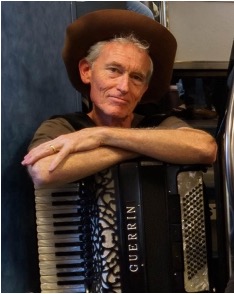
My friend John wears many hats, most of them big. I met him through our shared commitment to police abolition and mutual aid. We’re both part of Montclair Beyond Policing and the Montclair Area Solidarity Network. From the get-go, I could somehow tell that he was a musician – he just had that kind of vibe. Way back in college I had a zydeco and Cajun music show, and since then I have not really had people to talk to about those genres of music. As soon as I figured out John was also a fan, I felt an instant connection. Finally! Somebody I can talk to about Rockin’ Dopsie, BeauSoleil and Clifton Chenier. I’m sure I came on a bit strong with my pent-up zydeco passion, but to his credit, John wasn’t scared off.
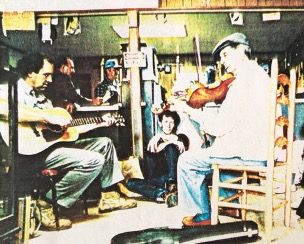
For my part, I was very impressed that once during a trip down to Louisiana, he actually got to hang out and play with his hero Marc Savoy (John is on the floor, Savoy is on the left, fiddle legend Dennis McGee is on the right). As I got to know him more, I learned about his musical history. Early in his musical career he played in a zydeco-punk (or punk-zydeco?) band named Jole Blonde, and his affection for zydeco and Cajun music has remained a driving force in his life. Currently he plays accordion in several bands, including Mr. Rose and Big Mamou. In addition to zydeco and Cajun music, his bands’ and his solo work draw on Appalachian, folk and other roots music. This diverse background has served him well when he has played with Richard Thompson (another one of his heroes).
John is a DIY and community-focused kind of guy. He has self-released his music, some of which is on vinyl (yeah!). He puts on shows in various places, including his house and friends’ backyards, and he is always willing to perform at local community-building events (like Montclair Zine Fest). Big Mamou plays regularly at Tierney’s and the Montclair Brewery in Montclair and Sunny’s and the 11th Street Bar in NYC. For the last few years, he has also organized an event called The World Turned Upside Down. This celebration takes place on the summer and winter solstices as part of Montclair Make Music Day, and it brings musicians and non-musicians together to perform folk songs.
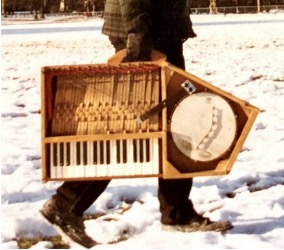
His DIY spirit includes the creation of new musical instruments. He invented something he calls the Kloppbox, which is a combination of keyboard, percussion instrument and kitchen sink. He also sampled the Kloppbox and built many of his songs around those samples, adding electronica to the rich mix of styles that he works with.
John Sherman Website: https://www.johnshermanmusic.com/
Mr. Rose, Don’t Call The Cops vinyl album linktree: https://ffm.to/w7q3ylj
John Sherman CD linktree: https://ffm.to/qq0e39o
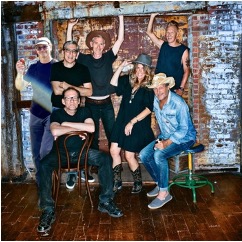
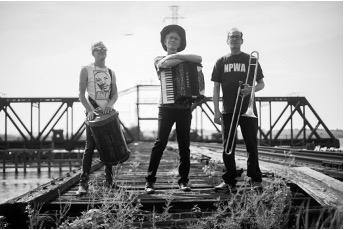
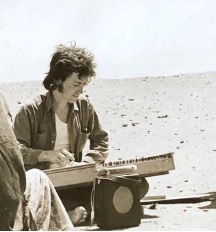
Big Mamou Mr. Rose John with Kloppbox in Morocco
Six of His Songs
1. Man In A Knot – Mr. Rose
This could have been a bit of playing to the crowd, since I included Man in a Knot on my 2024 end of year mix-list. However, John sincerely likes the song. He wrote it on the Kloppbox, although here it is performed on accordion with trombone and a hand drum. He said: ” It’s one of a few songs I wrote when I lived in New York, on 20th Street between 7th and 8th Avenue. It was across from a police station, and there was this bombed out shell of a car where some guy had gotten into it. In the middle of the night he was screaming, ‘Shut up.’ It struck me as both a moving and relevant thing to write about, somebody at the end of their rope. I mean, it’s criminal, really, the pain and the agony of so many people. It’s a little glimpse of that. I do what I can, but I wish there was more I could do to help.”
2. Phineas Gage – John Sherman
From a man in knot to a man with a steel rod in his brain. This recording includes the original Kloppbox samples the song is built around. If you don’t know Gage’s story already, you should definitely check it out. Here’s what John finds fascinating about it: “Although he survived the accident, his mind was affected. A friend of his said he wasn’t the same person anymore. He wasn’t polite and upstanding, and he showed up to work late, and things like this. But rather than giving him empathy, people rejected him. He ended up in a carnival freak show. In some ways, it isn’t so different from the guy in the bombed out car.”
3. I Apologize – John Sherman
John provided the inspiration for this song: “This is an old song. I played it with pretty much every band I’ve had since the 90s. I lived in Williamsburg for a while. I was on an L train in the middle of the night, and there weren’t that many people in the car. This guy broke into the song in the car and it was so impassioned. He had this whole James Brown thing going on. I pretty much just took his lyrics. People don’t apologize very often, and I think it’s a culturally neglected area. We have such a fucked-up mentality about just motoring through shit and not showing weakness. Also, my friends and I were heavily into African music and studying the whole 12-8 thing from West Africa. This is a good example of that.”
4. Mr. Rose – Mr. Rose
John explains: “Speaking of African music…it doesn’t sound anything like it, but I was heavily into Mbira music from Zimbabwe. A lot of those tunes, if you listen to them, they kind of toggle between just a couple of chords. I got very into trying to pick out the different melodies and did a lot of two chord songs. Super simple, with same two chords throughout, but the melodies changed a little bit. This was one of them. In terms of the subject matter, this was a lot about my father, but also about myself. I realized as I get older, I recognize a certain type of person in our modern-day world who doesn’t totally fit in.”
5. Take Me In Your Arms – Mr. Rose
The zydeco connection finally comes out: “The melody is lifted from Amede Ardoin’s song Quoi Faire and the words are all my own. They build on my interest in mythology. Ardoin was the first Black zydeco recording artist.”
Then John expounded a bit on accordions: “A lot of the inspiration for my accordion playing was from button accordions, which work very differently than the piano accordion that I play. So, writing this song was really a translation from the old Cajun button accordion – those suckers honk. They’re like, honk, honk, honk, honk, honk. If you’re in a juke joint and people are all ginned up and semi-violent, having that button accordion be able to be heard through the chaos is probably helpful. In order to translate that into a piano accordion, I had to jump through some hoops and do some funny moves, and that’s really what has created my particular style.”
6. The Big Man Can’t Help You – Mr. Rose
The story: “This is a very recent one, and is one of those songs that it came to me pretty quickly. The lyrics for this were based on a of couple photos I saw in the New York Times when that plane crashed into the Army helicopter in Washington, D.C. One of them had a crane fishing parts of the plane out of the water, and in the background was the Capitol Dome. This was right around the time where Trump was blaming DEI for the crash. It’s mournful, or a warning. If someone made me interpret it, it’s just in general, people still think that whether it’s some religious deity or some political entity, someone from the outside is going to come in and make it okay. That’s not going to happen. We got to do it ourselves.”
Six Songs That Inspired Him
1. What’s The Matter Now – Walker Brothers
John was enthusiastic about this choice: “I just listened to it recently again. It’s just like, oh fuck, yes! Yeah, yeah, yeah! It hits the groove and is driven by the accordion. I first played that song with Jole Blonde, that was my first Cajun punk band. It was important for us, and I have played it in every band since then.”
2. Roustabout – Fred Cockerham (song starts 2:15 in at the link to the album it’s from)
The backstory: “The whole thing with Jole Blonde was that we loved a combination of this Appalachian music, the Cajun music and African music really. That was what the inspiration was and it was all of a piece.
It wasn’t like they were separate things. That is still the case to this day, as far as my inspiration goes. My friend Mark, the guitar and banjo player in Jole Blonde, might have given me the Appalachian record this song is on. It just immediately grabbed me. Roustabout later became a Big Mamou song called Hop-On, which we play at pretty much every gig at this point.”
3. The World Turned Upside Down – Billy Bragg
John shares more about his musical history: “I never liked protest songs back when I was younger. Anytime Icaught a whiff of anything that was supposed to make you go out and do something, it was just like, nah. But I’ve come around to think that protest music is actually a good thing. And this song, and this performance of it, really moved me. The World Turned Upside Down event I organize is named after this song. This is the version I heard first, and then I went back to older versions of it. And something I think I appreciate more and more is that it’s not just the words, it’s the groove, too. I think that’s also true with Bob Dylan, more than people usually give it credit for. Most people think it’s mostly about the words with him, but I think for him it’s mostly about the music or the sound.”
4. Tear Stained Letter – Richard Thompson
On his hero: “Richard Thompson is a big part of my musical life. This is a live performance from the tour I was on with him in ’91. It’s not my favorite Richard Thompson song, but you’ll hear at the end of thesong one of many of his incredible guitar solos that just go on and on and on – just layers and layers. In my own bands, that’s something that I always strive for – these improvisational flights of fancy that just keep going on and on. As a performer, to be in the midst of those waves of improvisation is thrilling. Richard Thompson is the master of it to me.”
5. Cat Squirrel – Doctor Ross
To introduce this song, John said: “This is another one of these groove things. I didn’t really realize this before we started talking, but it’s exactly the same thing that’s going on with What’s the Matter Now and Roustabout and this one. They’re all songs that I continue to play in every band I’m in. It’s the same combination of basic kind of blues lyrics with this incredible music. I don’t know, it just transcends.”
I didn’t know this song, so afterwards I kept repeating some version of, “Holy cow! How have I never heard this song? It’s awesome!”
6. Zydeco Sont Pas (The Snap Beans Aren’t Salty) – Clifton Chenier
John’s selections appropriately ended with Clifton Chenier and the song that gave the genre its name: “To me, it’s an infectious kind of melody that seems to draw people in. A lot of people from a lot of different kinds of backgrounds appreciate it and like to dance to it.”
I’ve known the song for going on 40 years, but I never understood the title. John helpfully explained that, “It came from hard times when people couldn’t afford to put salt pork in their pot of beans. It was kind of a making the best of a hard time situation.” Having that decades long confusion cleared up for me was the cherry on top of a great conversation.
Baker’s Dozen
Madame Young – Dennis McGee
John: “It’s one of the songs I played that morning for Marc at his shop and a song we continue to do with Big Mamou.”
 Listening Station Eight