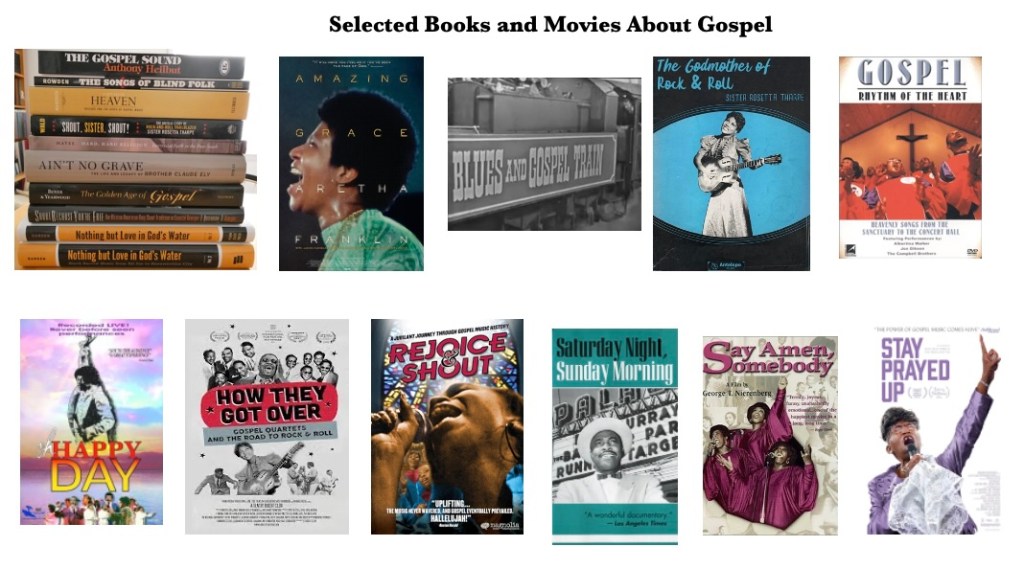
I once heard a reverend at a gospel show note that many people want to listen to gospel, but not hear it. I remember thinking, “Buddy, you don’t know even know the half of it.” My complicated relationship with religion goes all the way back to my childhood. In 2nd grade I loved going to church and I thought I might want to be a minister when I grew up. However, they started to lose me when they told me to stop asking questions (e.g., about the seemingly impossible logistics of repopulating the world after the flood). Since it was an Episcopal church, they should have just told me it was metaphorical and I’d probably have been OK with that explanation. That summer, I got kicked out of a Lutheran vacation bible school that took place in a church across the street from our house (Picture below: Inviting spot to spend the summer, no?). This occurred because I publicly questioned the reverend’s understanding of basic geology (e.g., “Reverend Aho, Hell is definitely not in the center of the Earth because scientists say that it is filled with molten lava”). In this case, I can’t really blame them for removing me. If you sign up for a Lutheran vacation bible school you pretty much know what you are getting yourself into.
Around that same time, my mother got me a paying gig in the choir of the church we attended. I earned 25¢ for rehearsing on Saturday and 50¢ for performing on Sunday. Since it was the early 70’s, this wasn’t bad money for an 8-year-old. And it was easy money, too, since I didn’t actually sing. I couldn’t carry a tune in a bucket (still can’t), but 75¢ was three comics or packs of baseball cards, so I wasn’t going to mess that up by making it clear that I wasn’t capable of doing what they were paying me for. I dutifully went to rehearsal and church week after week and just moved my mouth in what was probably a painfully bad job of lip syncing. The choir director never called me on it. My mom was the church’s secretary at the time, so perhaps she had some pull. As I got older, when she would drag me to church I would lip sync everything else, too. When she stopped dragging me, I stopped going.
Somewhat surprisingly, in college I was a religious studies major. Not because I had returned to the church, but because I was attracted to how interdisciplinary the major was and what kinds of questions it asked. Indeed, at that time I described myself as an atheist. Williams James, in his Varieties of Religious Experience, talks about his own experience of transcending the self and opening himself up the “more” of the universe. I, too, had a moment of feeling profoundly open to the universe, but instead of the “more,” I was met with an abject nothingness that shook me to my core. As I have gotten older the sense memory of that experience has faded, and my understanding of the limitations of my tiny brain has sharpened. I now describe myself as an agnostic. I don’t see any reason to believe in a God or gods, but who knows? More importantly, who cares? I figure the best thing to do is to just get on with it, take care of others and the planet and be a good person.
Despite my personal history and current outlook on religion, I still really dig gospel. I have heard other non-believing gospel fans suggest that they deal with the fact that they are not interested in the themes and contents of gospel songs by acting like they are listening to a language they don’t understand. After all, they say, those cool songs of the Pygmies might be all about loving or fearing God, but if you don’t speak Aka then you will never know and won’t be bothered by the religious content. That type of non-believing gospel fan is just focused on the sonic qualities of the singing, not the words. I can understand this to some extent, as I do like listening to Michael Stipe create a vibe by singing inscrutable lyrics. However, if I could just wake up one morning speaking Aka, I would be psyched to know what those Pygmy songs were actually about. Why wouldn’t I want to listen, understand and consider the meaning of the words being used? Even if I am not religious, there is still lots to learn and be moved by. I may not be hearing the gospel, but I sure as Hell am interested in listening as closely as possible.
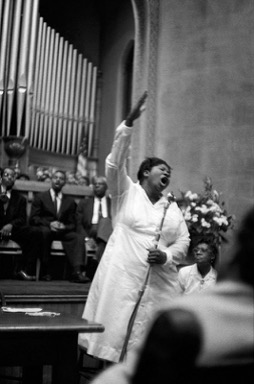
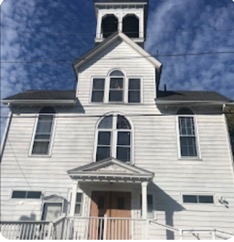
As with other forms of music, the terminology here can be a complicated. In everyday usage, gospel is a general, catch-all label to refer to just about any form of African American religious music, from 1800’s spirituals to 2000’s Kirk Franklin. It is easy short-hand, even if it is technically imprecise. As an analogy, consider the term classical music. Rather than referring specifically to a certain style of music produced from the early 1700’s to the early 1800’s (see Mozart, Haydn, Gluck, etc.), most people use it to mean any form of orchestrated music from the past. In the case of gospel, many experts who study this music use the term to specifically refer to a style of religious music originating in Chicago in the mid-20th century, principally developed by Rev. Thomas Dorsey and Sallie Martin and made popular by the likes of Mahalia Jackson, Marion Williams, and Shirley Caesar. Unlike the more self-consciously refined approach of the religious quartets that had been dominating the market, in Chicago the sound was clearly influenced by the blues. Indeed, Rev. Dorsey had played with Bessie Smith, and under the moniker Georgia Tom had recorded the ever-popular Tight Like That. The Chicago sound also maximized audience participation. The dancing, stomping and clapping of this new style scandalized more conservative church goers who associated the blues with the Devil, but it quickly grew in popularity. Eventually this developed into the smooth sophistication of groups like the Soul Stirrers (featuring Sam Cooke) and the more energetic “hard” gospel of performers like Rev. Julius Cheeks.
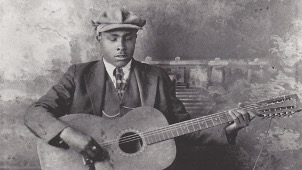
Even used in this more precise manner, I can still say that I like gospel music well-enough. However, what I truly love is the music of sanctified singers from the pre-WW2 era, particularly those who were street musicians. This is the gospel blues, featuring just a singer, a guitar and perhaps a back-up singer and slight accompaniment. For me, Blind Willie Johnson is the epitome of this style. I’m not alone in my appreciation of him, as his song Dark Was The Night, Cold Was The Ground was included in the collection of music NASA sent along with Voyager spacecraft. Even so, on the surface level, it could look like I’m just another white blues fan obsessing over some musician that made a limited amount of sides and then disappeared into the mists of legend. However, I think my fondness for sanctified singers runs deeper than that and is essentially connected to my relationship to religion. Two courses that I took while an undergrad still inform my thinking about this.
The first was a course on Kierkegaard. I think I took this too early in my studies, as some of it certainly went over my head. For example, he made extensive use of pseudonyms to simultaneously publish books that expressed contrasting viewpoints, so it was sometimes complicated to figure out how he was building his overall arguments. However, I understood what he was going for in Fear and Trembling. Rather than easily attained succor, Kierkegaard (writing as Johannes de silentio) suggests that God presents believers with challenges to be faced. This means that faith is essentially demanding, and not always a consolation. Having faced that abject nothingness, I understood the anxiety he was wrestling with at a somatic level.
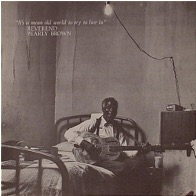
The second was a course I took on the Gospel of Mark. Over the course of the semester, we did a close reading of Mark, along with the three other canonical gospels. I’m not Christian, so I don’t have skin in the game, but to my mind Mark is the most compelling of the four and better expresses the idea that Jesus is making a sacrifice, or is being sacrificed. For example, in John, when Jesus dies upon the cross, he utters something along the lines of, “It is done.” The sense is that God’s plan has been completed, and Jesus has done his pre-ordained part. By contrast, when Jesus dies upon the cross in Mark, he laments out loud that he has been forsaken. Jesus, as a human, wonders why this terrible thing is happening to him. He is not just going through the motions of something that was inevitable – he is experiencing his pain and suffering in the moment, and he is confused. A reward may be waiting in the after-life, but that doesn’t mean this isn’t a mean old world to live in (to quote Rev. Pearly Brown).
I think the gospel blues capture this gut-churning aspect of the religious experience best, which is why I find them so compelling. For example, in Moan, You Moaners, Bessie Smith exclaims, “Religion turns you inside out.” That sounds like an intense experience, and not entirely pleasant. Similarly, Rev. Charlie Jackson draws on the imagery of Jesus being a fisher of men to say that he is Wrapped Up and Tangled Up in Jesus and that he doesn’t want to get loose. His electric guitar, coming in and out of the song and varying in volume and tempo, conveys the complicated nature of his faith – finding freedom in the joy of being bound. I prefer these more solitary expressions rather than the large and exuberant gospel choirs that celebrate how the Lord has made things right. Although they are undeniably energetic and technically impressive, I tend to listen to songs like Satan, We’re Gonna’ Tear Your Kingdom Down or I Walk With God from more of a distance. To me, these songs and the style of their presentation suggest that the tension of faith has been resolved to some extent. They are a collective celebration of getting over to the peaceful and shining side. Thematically, that is not as interesting to me as folks dealing with the demands of the here and now. And emotionally, either as religious fervor or as expressions of Black Joy, the feeling of community shared in these songs is definitionally outside of my experience.
I’m not against large choral singing entirely. For example, I am fascinated by both shape note singing in the white rural church tradition (e.g., Alabama Sacred Harp Singers) and lined out singing in both white and Black church traditions (e.g., Deacon Leroy Shinault). What I like about these styles is that it sounds as if the congregation is slowly coalescing while singing, like they are looking for the path but they have not found it just yet. Indeed, that is also why I like the sanctified singers. Even if they repeat Biblical directives about faith and the afterlife, they still sing about what it takes to survive on this side. They hope for transcendence, but like Jesus on the cross in Mark, they are completely in the moment. Their songs are moving accounts of private struggles rather than communal expressions of transcendence.
Indeed, I don’t know that anybody can improve on the wordless Dark Was the Night, Cold Was the Ground in terms of expressing a certain type of resigned existential despair. That same feeling is evoked by a number of other bracingly direct performances from this era. Lord I Just Can’t Keep From Crying, also by Blind Willie Johnson, is a powerful testament to reaching the breaking point. Gospel, yes, by being addressed to God, but the blues through and through. In I Don’t Feel At Home in This World Anymore, the Two Gospel Keys lament the fact that so many of their family members have passed away and explain they are waiting to join them. They testify that they are only passing by here on Earth, but yet here they remain. These deep worldly blues are also at the heart of Now is the Needy Time, recorded by Sister Clara Hudman. Lightnin’ Hopkins, and many others, performed it as Now is the Needed Time, which creates some ambiguity. The song can be about a time that you are in need, or a particular type of time that is needed.
Perhaps because of their personal scale, I take some solace in these understated appeals to grace. Of course, these are not limited to the era of sanctified singers. For example, the recording of Laura Rivers doing an a cappella performance in her living room of That’s Alright (Since My Soul Got A Seat Up in the Kingdom) really moves me. Similarly, There’s a Light by Shirley Ann Lee, and You Don’t Know What the Lord Has Done for Me by Annie Lee and Oscar Crawford with Annie Mae Jones, resonate because of the quiet confidence they exude. Perhaps the best example of this is the work of Washington Phillips. Playing his almost impossibly delicate sounding manzarene and singing in an unhurried fashion, it feels like he is giving me advice in the gentlest of manners. See for example, Take Your Burden to the Lord and Leave it There or Lift Him Up, That’s All. As an agnostic, I’m not going to do what he suggests, but I appreciate him thinking about me. In some way, I can also respect the concerns of Rev IB Ware with Wife and Son when they sing You Better Quit Drinking Shine. However, listening to them somehow makes me simultaneously feel the straight edge lifestyle calling and thirsty for some bootleg liquor.
When Sister Rosetta Tharpe sings about hearing music up above her head, I have a similar conflicted experience. I, too, can hear songs that are running through my mind (including hers) and the music of world itself (in both the Pythagorean and Cage-ean sense). When I sing along (in private, of course), her words seem to capture what I am feeling. But even so, I understand that we not singing about the same thing. I don’t share her faith or her belief in a heaven somewhere. In this way, what she is trying to communicate is both above and over my head. What is there to do in this situation? Following the advice of Washington Phillips, I will keep listening, that’s all.